

Rollover as Business Startups Financing Strategy
A ROBS 401(k), or Rollovers as Business Startups 401(k), is a financing strategy that allows individuals to use their retirement funds to start or buy a business without incurring early withdrawal penalties or taxes. It’s a unique way for entrepreneurs to access their retirement savings for business purposes.
The ROBS strategy is frequently used by entrepreneurs starting or buying a franchise, small business, or other ventures where traditional financing may be difficult to secure. Here’s a breakdown of how a ROBS 401(k) plan works.
1. Establish a C-Corporation
The first step is to form a C-Corporation (C-Corp). This is a requirement because the ROBS structure can only be done with a C-Corporation, not other types of businesses like LLCs or S-Corporations.
2. Create a New 401(k) Plan
After the C-Corporation is established, the business sets up a new 401(k) plan, which will allow the owners and future employees to participate.
3. Roll Over Existing Retirement Funds
Next, owners roll over funds from an existing qualified retirement account, such as a 401(k) from a previous employer or an IRA, into the new 401(k) plan that has been created for the C-Corporation. This rollover is not taxable, and owners who are not of qualified retirement age will avoid early withdrawal penalties.
4. Purchase Stock in the C-Corporation
The new 401(k) plan then buys stock (shares of equity) in the C-Corporation. This means the retirement funds are now invested in the C-Corporation, providing capital to the business without debt or loans.
5. Use the Funds for Business Expenses
Once the 401(k) plan purchases stock, the C-Corporation can use those funds to pay for business operations like inventory, equipment, salaries, or anything else necessary to run the business.
What do I need to know?
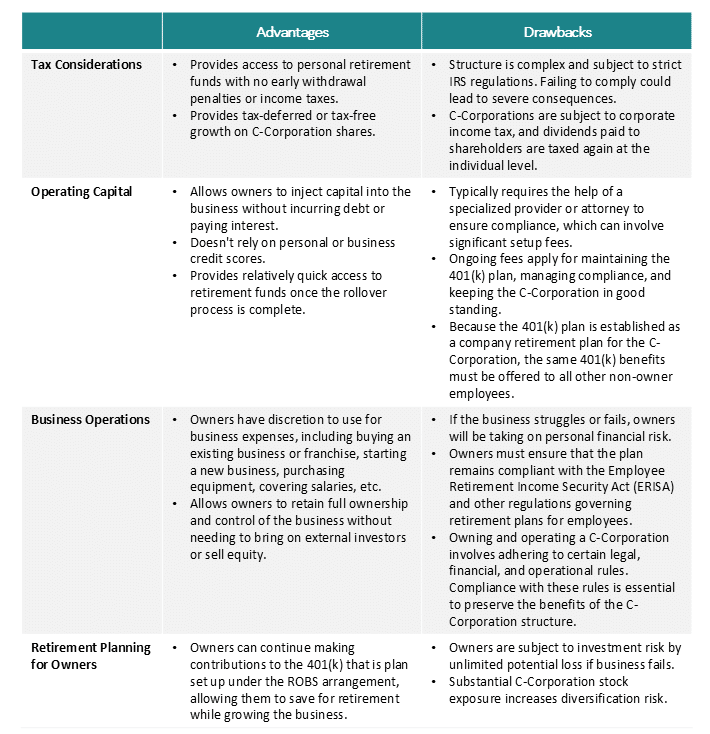
A ROBS 401(k) plan (Rollovers as Business Startups) offers several advantages for entrepreneurs who want to use their retirement savings to start or buy a business. While a ROBS 401(k) plan offers a unique way to finance a business using retirement funds, it also carries several risks. It’s important to work with an experienced ROBS plan provider or legal and financial advisors to navigate the complexities and reduce these risks.