
Tax Alpha: Building More Wealth Without Taking More Risk
Investment alpha comes from outperforming the market. Tax alpha comes from keeping more of what your portfolio, business, and other assets already earn. For affluent investors, the goal is not simply higher returns—it is greater after-tax, after-fee, after-inflation wealth.
That shift in perspective matters because thoughtful tax planning can improve outcomes without relying on more investment risk or market outperformance. The opportunity is often found in coordinating decisions that are made throughout the year, not just during filing season.
Three Ways Portfolios Can Create Tax Alpha
Tax-loss harvesting can turn market declines into a planning asset by realizing losses that offset gains, while keeping the portfolio aligned with its long-term strategy. Asset location places investments in the accounts where their tax characteristics are most efficient—for example, holding tax-inefficient income-producing assets in appropriate tax-deferred accounts when suitable.
Capital-gain management adds another layer of control. Rather than selling whenever a portfolio drifts, an investor can coordinate rebalancing, holding periods, income needs, and tax brackets to manage when gains are recognized. None of these strategies eliminates tax, but together they can improve the amount of wealth that remains available for compounding.
Planning Beyond the Investment Account
Tax alpha also comes from connecting investment decisions with charitable, retirement, and estate planning. Donating appreciated securities can support a charitable goal while potentially avoiding the immediate recognition of embedded capital gains. Roth conversions may move assets into a different tax treatment, while coordinated retirement withdrawal sequencing can help manage taxable income across account types and years.
For eligible individuals, qualified charitable distributions from an IRA can direct money to charity while receiving the tax treatment allowed under current rules. Estate tax planning can further shape how assets transfer across generations. And when wealth is concentrated in one company’s stock, a deliberate plan for diversification, charitable transfers, hedging, or staged sales can address both risk and tax exposure instead of treating the position as an isolated investment decision.
The greatest opportunity often appears when investment and business tax planning are considered together. Business income, equity compensation, liquidity events, deductions, estimated payments, and portfolio decisions can affect the same tax picture. Coordinating them helps avoid solving one problem while creating another.
Coordination Turns Tax Ideas Into a Discipline
Consider a $10 million portfolio earning 7% annually before tax. If coordinated planning produces an equivalent 8% after-tax outcome, the difference can compound meaningfully over a multi-decade horizon—even without assuming superior market performance. The exact result depends on timing, taxes, fees, and personal circumstances, but the principle is clear: a small improvement retained each year can become a substantial source of long-term wealth.
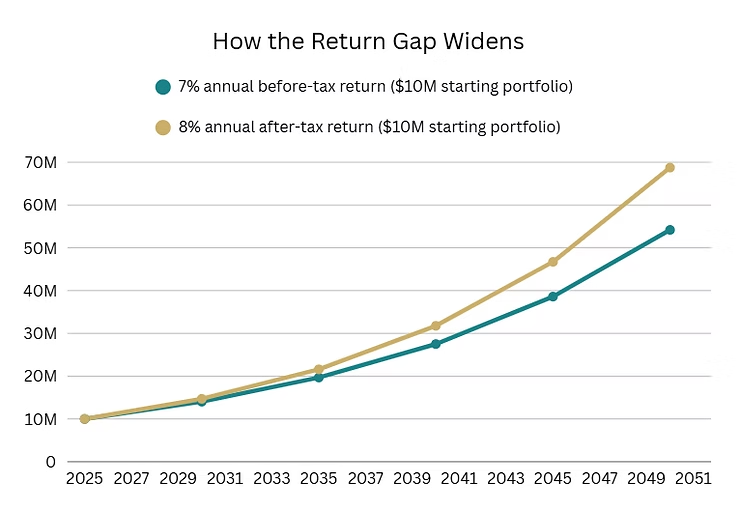
Illustrative compounding effect of a 1% improvement in annual after-tax returns on a $10 million portfolio. Actual results vary based on taxes, fees, timing, and individual circumstances.
Tax Alpha Is a Year-Round Value Proposition
Tax alpha is not a single tactic or an annual tax-return exercise. It is an integrated wealth-management discipline that coordinates investments, taxes, estate decisions, cash flow, risk, behavior, and family governance. When these pieces work together, tax management becomes an ongoing way to protect and compound more of the wealth you create.
The next step is to review upcoming decisions—not only last year’s return—with the professionals who understand your complete financial picture.
IMPORTANT DISCLOSURES: Tax outcomes depend on individual circumstances, changing laws, account rules, and transaction timing. Evaluate these strategies with qualified tax and financial professionals before acting. All written content on this site is for information purposes only. Opinions expressed herein are solely those of Omnia Executive Retirement and our editorial staff. Material presented is believed to be from reliable sources; however, we make no representations as to its accuracy or completeness. All information and ideas should be discussed in detail with your individual adviser prior to implementation.